


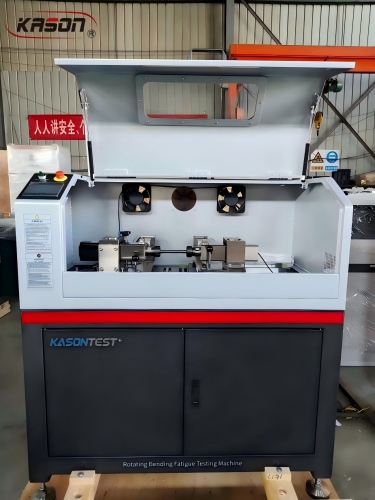
Rotary Bending fatigue testing is a core method to evaluate fatigue limits and generate S-N curves for shafts, wires and structural components. ISO and ASTM standards impose strict requirements on equipment torque control, rotational speed accuracy, loading stability and data traceability. Traditional counterweight-based fatigue Testers suffer from large loading errors, limited Test conditions and incompatibility with high-temperature Testing, failing to meet multi-standard compliant testing simultaneously. The KASON-BP300C adopts a full closed-loop servo loading architecture, fully matching test specifications of international standards at the hardware level.
Core Performance Meets Strict International Precision Criteria
The machine reaches a maximum rotational speed of 6000 r/min, with loading torque ranging up to 100 N·m and loading force spanning 100 N to 1000 N. It features a force resolution of 0.05 N, relative loading force error ≤±0.5% and in-operation force fluctuation controlled within ±5% — fully satisfying the precision requirements of force measurement systems specified in ISO 1143 and ASTM E2948. Equipped with a fixed 100 mm force arm, the tester automatically calculates bending moment via PLC without manual conversion. Its unique structural design eliminates systematic bending moment errors induced by component gravity on specimens, a long-standing flaw of conventional fatigue test equipment.
Built with a high-rigidity integrated frame, precision linear guides and ER25 high-precision elastic collets, the machine firmly clamps standard dumbbell-shaped cylindrical specimens with clamping diameters from Φ8 mm to Φ16 mm. It supports both room-temperature and high-temperature testing, with an optional vortex tube cooling device to maintain constant specimen temperature, covering test scenarios for ASTM wire fatigue and ISO bar rotary bending. Users can adjust rotational speed and applied bending moment steplessly during operation. The unit automatically stops and stores all test data once specimen fracture occurs. Paired with self-developed TestPilot dedicated test software, the system displays real-time bending moment-time curves, automatically records cycle counts and generates archivable standard test reports. Test data can be uploaded to laboratory digital management systems via RS232/RS485 serial ports to support data traceability and third-party inspection compliance.
Complete Safety & Modular Configuration
Full safety protections comply with laboratory operation standards, including fully enclosed protective covers with door interlock shutdown, overpressure, overcurrent and overvoltage protection. The four-point bending structure consists of two moving loading units with servo electric cylinders to apply symmetric and uniform bending moment, perfectly replicating the four-point rotary bending test conditions defined by ISO 1143. Standard configuration includes servo drive assemblies, high-precision force sensors, PLC touchscreen control system, special fixtures and a supporting computer. Vortex tube cooling devices and air compressors are available as optional accessories to accommodate differentiated high/low-temperature testing needs for wires and bars.
With overall dimensions of 800×600×1260 mm, the compact tester only requires a single-phase 220 V, 1 kW power supply for stable operation, fitting space constraints of university material labs, enterprise R&D quality inspection centers and third-party testing institutions. All key transmission, sensing and electrical control parts adopt premium branded components for outstanding durability and low long-term maintenance costs.
Industry Value
The KASON-BP300C integrates compliance with ISO, ASTM and Chinese national standards in one single unit, breaking the high-price monopoly of imported test equipment and eliminating the procurement burden of purchasing separate testers for different standards. It is widely applied in fatigue performance research and factory quality inspection of bearing steel, aerospace alloys, spring wires and mechanical shaft parts, facilitating mutual recognition of test data for metallic materials across markets.
Contact me if you are interested!
Email: admin@jnkason.com
Whatsapp: +86 15910081986