


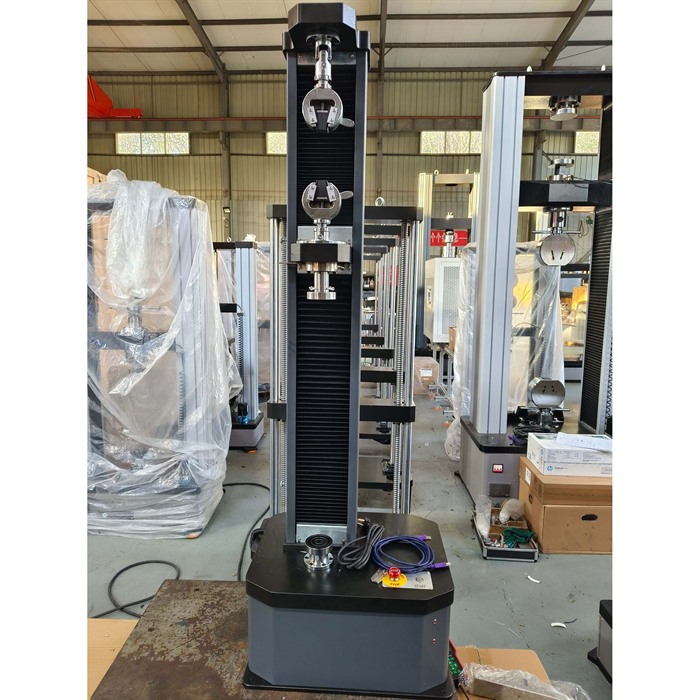
KASON ETM104W-D is a single column computer control electromechanical Universal Testing Machine in the single column testing machine range. A single column frame exists for a simple reason: not every specimen needs a heavy twin column frame to break it. Rubber, film, foil, textile, adhesive, paper, foam and the small plastic or electronic components that go into a finished product all fail at forces a compact frame can deliver, and they need a machine that is tall enough to hold a long specimen and sensitive enough to see the first part of the curve. What separates one single column machine from another is rarely the pulling; it is whether the machine knows what the specimen is doing while it is being pulled.
Key Takeaways
- The frame is built for Testing in two directions: a tensile Test pulls downward in the lower space, and a compression or bending set-up works upward in the space above it.
- Control is closed loop on three channels, force, displacement and deformation, so a test can be run at a controlled stress rate or strain rate rather than only at a crosshead speed.
- Modulus, yield strength and proof stress are calculated from measured deformation, which is why an Extensometer matters more than the frame on these materials.
- The controller is a digital unit with a separate software layer on the computer, so methods, curves and reports are handled where a laboratory can archive them.
- A hand-held controller and a positioning ruler along the frame make it practical to set the starting gap for bending and compression work without walking back to the keyboard.
One Frame, Two Test Spaces
The moving crossbeam sits between the top of the frame and the base, which gives two working areas in one column: the space below the crossbeam for a tensile test, where the grips pull the specimen apart, and the space above it for compression, bending or a Compression Platen set-up. For a laboratory that tests the same material in more than one mode, this avoids buying two frames, and it avoids rebuilding the machine between a tensile run and a compression run. The frame itself is a rigid column with a recirculating ball screw drive, so the crossbeam moves on a precise thread rather than on a chain, and the alignment of the two grips stays where it was set when the frame was levelled.
Closed Loop on Three Channels
A basic machine controls one thing: how fast the crossbeam moves. That is enough to break a specimen, and it is not enough to characterise one, because the crosshead includes the compliance of the grips, the Load Cell and the specimen shoulders in every millimetre it travels. The ETM104W-D closes the loop on force, on displacement and on deformation, which means the operator can choose which quantity is held constant during a test. Running at a controlled stress rate matters when a standard specifies how fast the load may be applied; running at a controlled strain rate matters when the interesting part of the curve is the elastic region, where the specimen moves very little for a large change in force. Being able to change the control mode part way through a test is what makes it possible to follow a method that asks for one rate up to yield and a different rate afterwards.
Why Extensometers Decide the Result
On a plastic, a rubber or a thin film, the extension at yield is small and the specimen shoulders move as much as the gauge length does. If strain is inferred from crosshead travel, the modulus that comes out of the test includes the stiffness of the load train and the seating of the grips, and the value will not agree with another laboratory running the same standard. An extensometer clips onto the specimen itself, over a defined gauge length, and measures only what happens between its arms. That is the measurement the machine's deformation channel is built to accept, and it is why the frame is offered with clip-on, long travel and non-contact options: a long travel extensometer for elastomers and films that stretch far, and a non-contact or video type where the specimen is too soft, too hot or too thin to carry a clip.
What the Standards Require of the Measuring Chain
The frame and its electronics are verified against the force standards that apply to any Universal testing machine, ISO 7500-1 and ASTM E4 among them. The strain side has its own set, and it is the one that decides whether a modulus figure is defensible:
- ISO 9513, which covers the calibration of extensometers used in uniaxial testing and sets the accuracy classes a laboratory has to declare
- ASTM E83, the corresponding practice for verification and classification of extensometers
- EN 10002-4, the European standard for verification of extensometers used in tensile testing
A laboratory that reports modulus or proof stress to a customer is normally asked which class of extensometer was used and when it was last verified, which is why the deformation channel and the extensometer are treated as one measuring system rather than as an accessory.
Software, Methods and Reports
The computer layer is where a Testing Machine becomes a laboratory instrument rather than a press. Test methods are stored and loaded, so the same operator can move from a tensile test on a plastic to a compression test on a foam without rebuilding a method by hand. The curve is displayed live and can be re-analysed after the test, which matters when a result is questioned: the raw data is still there, and the analysis can be repeated on it. Results are exported to spreadsheet and word processor formats, and the report template can carry the test standard, the operator, the curve and a company logo, so what leaves the laboratory looks like a test report and not a printout of numbers.
Where This Machine Fits
Typical work is tensile, compression, bending, shear, peel and tear testing on rubber and elastomers, plastic film and sheet, foil and packaging laminates, adhesive joints, paper and board, foam, textile and cord, small wire and medical or electronic components, with a temperature cabinet where the test has to be run hot or cold. A single column frame of this class is not the right machine for structural steel, and it is not meant to be; it is the machine for the materials that decide whether a product survives being handled, packed, dropped or sterilised.
Frequently Asked Questions
1. Why choose a single column frame instead of a twin column machine?
Because the specimens are small and the forces are moderate. A single column frame is more compact, easier to align and cheaper to run for rubber, film, textile, adhesive and small component testing. Twin column frames come into their own when the specimen is large, the force is high, or a wide bending fixture has to fit between the columns.
2. Do I need an extensometer if the machine already measures displacement?
Yes, if modulus, yield or proof stress has to be reported. Crosshead displacement includes the compliance of the grips and the load frame, and on a soft material that compliance is a large fraction of the total movement. An extensometer measures the specimen alone, which is what the standard assumes.
3. What is the advantage of closed loop strain control?
The test can be driven by what the specimen is doing rather than by how fast the motor turns. That is what allows a specified stress rate or strain rate to be held, and it is what makes a test reproducible between operators and between laboratories.
4. Can the machine run compression and bending as well as tension?
Yes. The lower space takes a tensile set-up and the upper space takes compression Platens or a bending fixture, so the same frame covers both without being rebuilt. The hand-held controller and the positioning ruler along the column help set the starting position for those tests.
5. How is the machine verified after installation?
The force channel is verified against ISO 7500-1 or ASTM E4 with reference load cells or weights, and the extensometer is verified against ISO 9513, ASTM E83 or EN 10002-4 depending on the market. Both are normally repeated at intervals, and the certificates are what a customer's quality department will ask for.
Contact me if you are interested!
Email: admin@jnkason.com
Whatsapp: +86 15910081986