


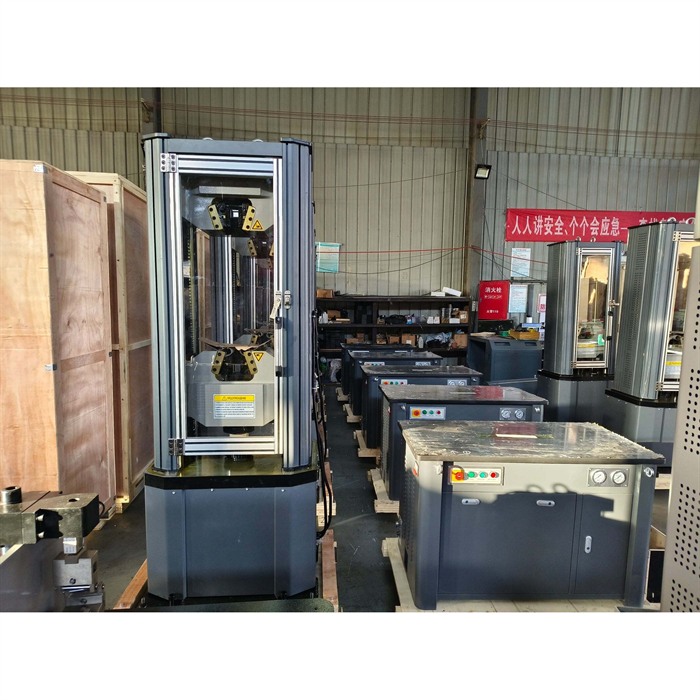
KASON HUT106W is a servo Hydraulic universal testing machine in the hydraulic universal testing machine range, built around a six column frame and hydraulic wedge grips. A hydraulic machine is not simply a stronger version of an electronic one. The reason a laboratory buys one is that the specimens it has to break are awkward: a bolt that must fail in the thread rather than at the grip, a welded fabric sheet that has to be pulled by two bars at the same time, a plate thick enough that the grips have to bite hard before the Test can even start. Those specimens decide the design of the frame, the grips and the control system, and this machine is built for exactly that work.
Key Takeaways
- Six columns, four guides and two screws, give the frame the stiffness and the axial alignment that a high force tensile test needs.
- Hydraulic wedge grips clamp the specimen by oil pressure rather than by hand, so thick plate and large diameter bar can be gripped without a struggle.
- The frame has two test spaces: tension in the upper zone, compression, bending and shear in the lower zone, so one machine covers several methods.
- Control is closed loop on force, deformation and displacement, which is what allows a test to follow a specified loading rate rather than only a crosshead speed.
- The machine is aimed at three product families that are often tested in the same laboratory: metal products, fasteners, and steel for concrete reinforcement.
Why the Column Count Matters
On a high force tensile test the specimen does not only pull; it also tries to bend the frame. If the frame deflects, the specimen is loaded off axis, the stress distribution across the section stops being uniform, and the strength that comes out of the test is lower and less repeatable than it should be. A six column arrangement, with four guide columns sharing the load and two screws driving the crossbeam, spreads that load over more structure than a two column design can. The practical effect is seen in the elastic part of the curve, where a stiff, well aligned frame produces a straight line instead of a scatter of points, and in the fracture, which happens where the specimen is weakest rather than where the grip happened to bite hardest.
Hydraulic Wedge Grips and Half-Open Jaws
On a hydraulic machine the gripping force comes from the same hydraulic system that loads the specimen, so the harder the machine pulls, the harder the wedges bite. That is what makes it possible to test large diameter bar and thick plate without a manual tightening step for every specimen. The jaws are designed half open at the front, so the operator can offer the specimen into the grip and see where it sits before the clamp closes; on a heavy specimen that is the difference between a two person job and a one person job. Round and flat jaw sets cover bar, rod, wire, strip and plate, and the same frame accepts chain, welded fabric, bolt and nut, shear, compression and bending attachments, which is why the machine can be the only frame in a small laboratory.
Two Test Spaces, Three Control Loops
The moving crossbeam divides the frame into a tensile zone above and a compression, bending and shear zone below. Between tests the crossbeam is positioned by a motorised drive, and the fine positioning for a bending or compression set-up is done from a hand-held controller at the frame rather than from the keyboard, which keeps the operator's eyes on the specimen. Control is closed loop on three channels: force, deformation and displacement. Force control holds a loading rate, deformation control holds a strain rate measured on the specimen, and displacement control holds a crosshead speed. Being able to switch between them during a test is what lets one method be followed from the elastic region into yield and then into the plastic region at the rates the standard asks for.
Three Product Families, Three Standards
The specimen list for this machine is short but it covers three different industries, and each has its own standard that the laboratory will be asked about:
- Fasteners. Bolts, screws, studs, nuts and washers are tested for tensile strength, proof load and shear. ISO 898-1 defines the property classes and the mechanical properties for carbon and alloy steel bolts, screws and studs, and ASTM F606 covers the test methods for externally and internally threaded fasteners, washers, direct tension indicators and rivets. A wedge tensile test, where the specimen is pulled through an angled wedge so that the head is bent as it is loaded, is the test that separates a good bolt from a bad one, and it needs a frame that can pull hard without introducing its own bending.
- Steel for concrete reinforcement. Bar, wire and welded fabric are tested for tensile strength, yield, elongation and, for fabric, the shear strength of the weld. ISO 15630-2 sets out the test methods and the measurement of geometrical characteristics for welded fabric and lattice girders, including how the crossing welds are loaded in shear. A fabric sheet is an awkward specimen because the load has to be applied to two bars at once and kept symmetrical; the wide test space and the flat jaw sets are what make that practical.
- Metal products in general. Wire, rod, tube, strip and plate are pulled, bent, flattened or sheared, with the results reported as strength, elongation and reduction of area.
Software, Records and Traceability
The computer layer is where a hydraulic frame becomes auditable. Test methods are selected from a library that covers the common national and international standards, the specimen information is entered once, and the curve is plotted live while the test runs. After the test the curve can be re-analysed, the report can be exported to a spreadsheet or word processor template, and the load can be displayed in whichever unit the customer's specification uses. An optional camera can record the test itself, which is worth having when a fracture location is disputed: the video shows whether the specimen failed in the gauge length or in the grip, and that distinction decides whether the result is valid.
Frequently Asked Questions
1. Why choose a servo hydraulic machine instead of an electronic one?
For force and for specimen size. An electronic frame with a ball screw drive is precise and clean, but above a certain force and specimen thickness the hydraulic frame with wedge grips is the practical choice, and it holds a load for long periods without the screw drive having to work against it.
2. Can the same frame test tension and compression?
Yes. The tension zone is above the moving crossbeam and the compression, bending and shear zone is below it, so the machine does not have to be rebuilt to change method, only re-fitted with the appropriate platens, rollers or grips.
3. How are bolts tested so that they fail in the thread and not at the grip?
With the right jaw set and, for property class verification, a wedge tensile set-up. The grips have to be hard enough and long enough to hold the shank without marking it, and the frame has to stay aligned so that the bending introduced by the wedge is the only bending in the test.
4. What is needed to test welded fabric?
A wide enough test space and flat jaw sets that can grip two bars at the same distance from the centre line, plus the shear attachment for the weld itself. The method and the geometrical measurements are defined in ISO 15630-2.
5. How is the force measurement verified?
With reference Load Cells or dead weights, following the force verification standard the laboratory works to, and repeated at intervals afterwards. The calibration certificate is what a customer's quality department asks for when a test report is questioned.
Contact me if you are interested!
Email: admin@jnkason.com
Whatsapp: +86 15910081986