


Abstract
Selecting a suitable high-low-temperature Universal Testing Machine depends heavily on your target temperature range, Test force requirements, specimen categories, accuracy grade and long-term operational stability.
Understanding High-Low-Temperature Electromechanical Testing Machine Ecosystem
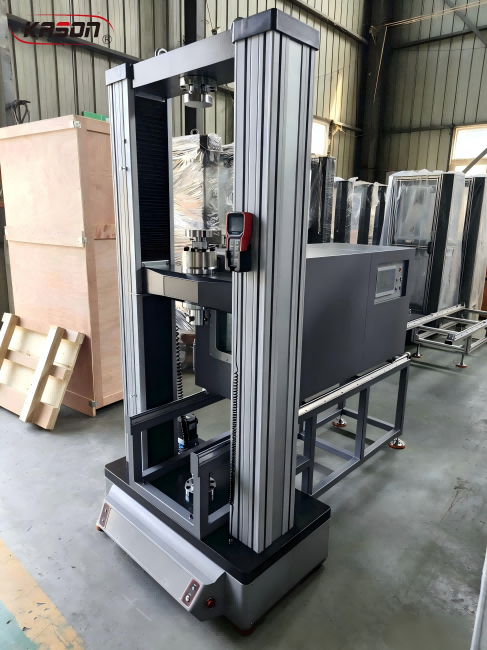
Similar to ordinary universal testers, a high-low-temperature electromechanical Testing machine consists of two core modules: high-stiffness main load frame, plus precision measurement-control system matched with a high-low-temperature environmental chamber.
Two Market Types: Premium Overseas Brands vs. Cost-Competitive KASON High-Value Series
|
Feature |
Premium European / US Brands |
KASON High-Value Series |
|
Accuracy Class |
Class 0.5 / Class 1 |
Class 0.5 high-precision grade |
|
Configuration |
Fully imported assemblies with high investment |
Key imported sensors + mature domestic integration |
|
Price |
Substantial capital outlay |
Competitive, excellent cost-performance ratio |
|
After-sales Service |
Slow response, expensive spare-part supply |
Global customer service, fast local support |
|
Typical Application |
Top-tier research laboratories |
Industrial QC, university labs, commodity-inspection institutions |
Application & Tested Materials
· Metals: alloy parts, metallic sheets, profiles for high/low temperature service condition
· Plastics & Composites: plastic profiles, pipes, sheets, thin films, composite laminates
· Rubber & Polymers: rubber products, waterproof membranes, wire-cable insulation materials
· Geo-textiles and other engineering flexible materials
· Test items: tensile, compression, bending, peeling, tearing, shear tests under preset high or low temperature environments
The machine complies with global mainstream testing standards. Its load measurement fulfils ASTM E4, ISO 75000-1, EN 10002-2, BS 1610, DIN 51221. Strain-measurement performance satisfies ASTM E83, ISO 9513, BS 3846, EN 10002-4. It supports metal high-temperature tensile ASTM E21, ISO 6892-2 and metal low-temperature tensile ISO 6892-3, as well as plastics, rubber and geotextile related ASTM / ISO norms.
Mechanical Structure & Stability Advantages
· Four-column high-rigidity load frame with heavy-duty pre-loaded bearings
· Pre-loaded precision ball-screw drive: high travelling speed, low noise, excellent positioning accuracy
· Symmetrical drive layout improves frame stiffness and keeps good axial alignment during long-time thermal-cycle tests
· Human-factor-optimised frame design to minimise operator fatigue during fixture-changing
· Interchangeable high-accuracy USA-origin Load Cell, capable of full-range capacity application
· Ample working space; spacious legroom below main frame for convenient specimen-fixture mounting and removal
Intelligent Software Functional Highlights
· Fully-digital closed-loop control for load, displacement and deformation channels
· Supports multi-control modes: displacement control, force control, deformation control, stress / strain constant-value control
· Intuitive curve processing: real-time rendering, zoom-in/out, curve overlay and exporting; test-point coordinate reading available
· Automatic calculation for yield strength, tensile strength, elongation and other key material indicators
· Multi-level user-authority management for system safety
· Built-in massive test-standard libraries covering ASTM, ISO, EN, DIN, BS series
· Multi-language support: English (standard), Russian, Turkish, Spanish etc.
· Database-oriented data storage; convenient data query, export and secondary processing
After-sales Support (Highest Priority)
· Remote video-guided installation, online operation training and troubleshooting service
· Machine independently designed and manufactured in-house by KASON factory
Total Cost of Ownership
· Optimised mechanical structure lowers daily maintenance workload
· Mature compressor-based temperature-control chamber reduces failure probability
· Standard complete accessories decrease extra-procurement expenses
· Customisable frame dimension, power-supply configuration, tensile space and test speed upon client demand
Compliance & Certification
The equipment meets EU CE safety directives EN 50081-1, EN 61010-1 and other related norms. It satisfies third-party laboratory-inspection and enterprise-product-certification requirements.
Available Customisation Options
Extra-wide or extra-height load-frame versions are available. Tensile clearance, test width, cross-head speed and power-supply system can be tailor-made to satisfy unique specimen-size or special-process requirements.
Making a Well-Inced Decision
Whether you are performing material-science research, incoming-material quality inspection or product-performance verification under extreme thermal environments, KASON-EGD high-low-temperature electromechanical testing machine offers balanced performance, reliable temperature-controlling capacity and competitive total-cost-of-ownership. It is a practical testing choice for rubber-plastic, composite-material, metal-processing factories and research-education institutions.
Frequently Asked Questions (FAQ)
1. What testing scenarios fit KASON-EGD best?
It is designed for tensile, compression, bending, peeling, tearing and shear mechanical-performance tests for metals, plastics, rubber, composite and geotextile samples within -60 ℃ ~ 300 ℃ temperature interval. It applies for R&D laboratories, QC workshops and commodity-inspection organisations.
2. Is it possible to switch test between room-temperature and high-low-temperature condition?
Yes. When removing the environmental chamber, the main frame can directly complete regular room-temperature mechanical tests. Chamber and main-frame adopt modular-assembly design.
3. Can the machine meet international standard-test requirements for high-low--temperature mechanical-property evaluation?
Yes. It fulfils ASTM E21, ISO 6892-2, ISO 6892-3 as well as a wide range of ASTM / ISO standards for plastics, rubber and geotextiles. Test reports can be used for third-party assessment and product-certification submission.
4. Are customised dimensions or special fixtures supported?
Absolutely. Tensile space, test width, cross-head speed, chamber inner size and fixture sets can be customised according to client specimen specifications.
Contact me if you are interested!
Email: admin@jnkason.com
Whatsapp: +86 15910081986