


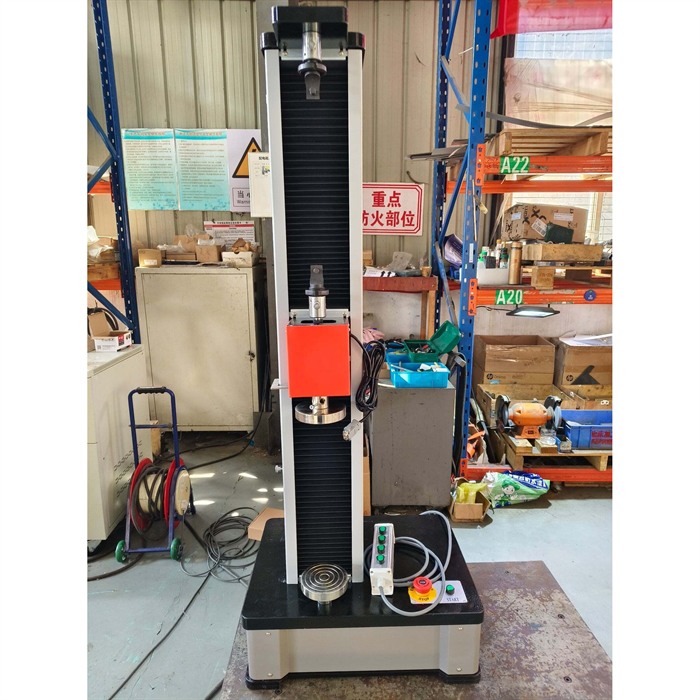
KASON TLW is a computer controlled spring tensile and Compression Testing Machine built on a single column frame, and it belongs to the spring tensile and compression test machine family. Spring makers use it to answer four questions about a spring: what force it delivers at a given length, what length it reaches under a given force, how far it deforms, and how stiff it is. The TLW series handles small coil springs and elastic elements in both tension and compression, which is why a single bench can carry both incoming wire checks and finished product release.
Key Takeaways
- Four measurement modes mirror the way spring data is actually specified: force at a set height, height at a set force, deformation at a set height and deformation at a set force.
- Tension and compression springs run on the same machine, so a spring line does not need two benches to qualify incoming material and outgoing product.
- The control software acquires data and draws the curve during the Test, then processes, stores and prints the result without a manual transcription step.
- Overload, travel limit, over-current, over-voltage and over-speed protection are built in, and the machine calibrates, stops and returns without waiting for the operator.
What the TLW Series Is Built For
The machine is aimed at precision springs and elastic elements rather than heavy suspension hardware. Typical specimens include tension springs, compression springs, disc springs and saucer reeds, tower springs, leaf springs, clip springs, flat springs, composite springs, gas springs, mould springs and pre-set or deformed springs. For each of them the machine performs tensile, compression, displacement and rigidity Testing and analysis, which covers the measurements that appear on a spring drawing: load at a stated length, length under load, rate and permanent set.
Four Ways to Interrogate a Spring
Spring data is rarely written as a single number, which is why the controller is organised around four modes instead of one. In the first mode the operator enters the remaining height a spring should reach and the machine measures the force at that height. In the second, the operator enters a deformation and the machine measures the force required to produce it. The third and fourth modes work the other way round: the operator enters a force and the machine reports the resulting remaining height or the resulting deformation. Running the same spring through more than one mode is what turns a single load reading into a stiffness figure and a set of acceptance limits, and it is the fastest way to catch a coil that is stiff but still inside its dimensional tolerance.
Single Column, Double Space
The frame is a single column with the moving beam suspended between an upper and a lower test space, so extension springs are pulled in one zone and compression springs pressed in the other without rebuilding the fixture stack. That keeps the footprint small enough for a bench while leaving a genuine second test space available. The drive is a high precision motor and driver set matched to a load sensor, which is what allows the loading speed to be set and held instead of drifting with friction, and the Compression Platens are machined so that the upper and lower faces stay parallel under load and stay centred on the spring axis. A clear positioning scale along the column lets an operator confirm travel visually as the spring is compressed.
Software, Data and Safety
The measurement and control software is made up of dynamic communication, data acquisition, result observation, record query, data processing and printing modules. Data is collected continuously during the test and the curve is drawn live, so a mis-seated spring is visible before the run finishes. When the test ends the software processes and saves the result automatically, and the operator can call any previous test back up and print the report. Force display, speed setting and batch testing are all available from the same interface, and the machine can be connected to a factory local area network or to the Internet for data transmission, storage and network printing. The safety package covers overload, travel limit, over-current, over-voltage and over-speed conditions, and automatic calibration, automatic setting, automatic stop, automatic return and break detection remove most of the manual set-up that a mechanical spring Tester needs.
Standards and Applications Covered
Spring standards from the DIN, EN, JIS and ASTM families are all served by this machine, and the three below are the ones most often written into a purchase specification for compression and extension springs. Each of them defines the force-at-length data that this machine is designed to produce:
- DIN 2095, quality specifications for cold coiled compression springs made of round wire
- DIN 2097, quality specifications for cold coiled tension springs made of round wire
- EN 13906-1, cylindrical helical springs made from round wire and bar, compression springs
Because the measuring system is calibrated against a force reference rather than set by a mechanical pointer, results can be used for incoming inspection, batch release and third-party reports rather than as an in-house indicator only.
Frequently Asked Questions
1. Can one machine really test both compression and extension springs?
Yes. The frame provides an upper and a lower test space, so extension springs are pulled in one zone and compression springs pressed in the other with the appropriate fixture. The same software handles both, and the four measurement modes apply to either direction.
2. How is stiffness obtained without a separate test?
From the recorded force and deformation data. Because the machine logs force, displacement and deformation continuously and draws the curve live, the spring rate is derived from the same run that produced the load readings, instead of being calculated afterwards from two separate bench measurements.
3. What protects the machine if a spring is set up incorrectly?
Overload protection, travel limit protection, over-current, over-voltage and over-speed protection are all fitted. The controller stops the test and returns the beam automatically, and break detection ends the run when the spring gives way, so a wrong gauge length does not turn into a damaged sensor.
4. Can the results go straight into factory quality records?
The machine offers a network interface and can connect to a factory local area network or the Internet for data transmission, storage, printing and network printing. Batch testing is supported, and records can be queried and reprinted from the software, so the paper trail is produced by the test itself.
5. What if the spring programme grows beyond tensile and compression testing?
The same supplier range covers spring torsion testing machines and spring fatigue test machines, and additional grips and fixtures can be added as specimen types change, so the bench can be extended rather than replaced.
Contact me if you are interested!
Email: admin@jnkason.com
Whatsapp: +86 15910081986