



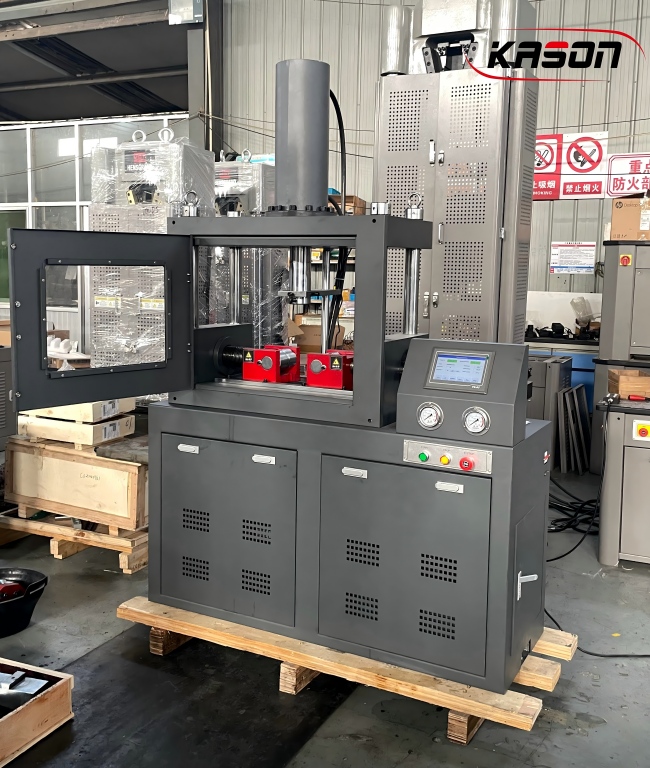
 1. Equipment Introduction
The vertical rebar bender consists of four core components, each playing a vital role in ensuring stable and precise operation. First, the mechanical structure includes a vertical frame, a bending mandrel, a clamping mechanism, and a movable bending head. The frame is made of high-strength steel to bear the pressure generated during bending, while the bending mandrel and clamping mechanism—processed by special heat treatment—ensure wear resistance and strong clamping force to avoid rebar slipping during processing. Second, the control system is mainly composed of a PLC controller, a touch screen operation panel, and a servo drive system. Most models are equipped with imported CNC control systems, enabling intuitive parameter setting (such as bending angle, rebar diameter, and bending speed) and supporting storage of up to 100 or more bending shapes for quick call during batch processing. Third, the power system can be electric, hydraulic, or servo-driven: electric models are suitable for medium and small-scale projects, hydraulic models offer strong thrust for thick rebars, and servo-driven models ensure high positioning accuracy and fast response speed. Fourth, the auxiliary components include an automatic feeding rack, a mold replacement kit, and a safety protection device. The automatic feeding rack reduces labor intensity by automatically moving raw materials, while the replaceable molds allow the machine to handle different rebar diameters (usually 6mm to 40mm) and bending shapes.
2. Key Features
- High Precision and Consistency: Controlled by servo motors and closed-loop control technology, the bending accuracy can reach ±2mm in length and ±0.5° to ±1° in angle, ensuring that each bent rebar meets the design requirements of engineering drawings. The CNC system eliminates human errors caused by manual operation, achieving consistent quality of batch-produced rebars.
- Efficient and Labor-Saving: The vertical design allows for one-person operation, and the dual-head models can complete bidirectional bending in a single cycle, with a daily processing capacity of up to 5,500 to 8,000 bars—equivalent to the workload of 12 traditional workers and more than 10 times the efficiency of manual processing. The automatic feeding and shape storage functions further reduce labor intensity and improve production efficiency.
- Wide Adaptability: It can process various types of rebars, including round steel bars and threaded steel bars, with a diameter range of 6mm to 40mm (depending on the model). By replacing different molds, it can bend rebars into angles ranging from -120° to 180°, as well as complex shapes such as arcs, rings, and horseshoe bars, meeting diverse construction needs.
3. Applications
- Transportation Infrastructure: Applied in highway, high-speed railway, bridge, and subway projects. It is used to process rebars for bridge piers, track foundations, tunnel support structures, and other components that require high precision and strength.
4. Selling Points
- Space-Saving and Flexible: The vertical layout occupies less floor space compared to horizontal rebar benders, making it suitable for construction sites with limited space. It can be easily moved and installed, enabling on-site processing and reducing the transportation cost of pre-bent rebars.
In summary, the vertical rebar bender combines precision, efficiency, durability, and intelligence, making it a core equipment in modern rebar processing. It not only improves construction quality and efficiency but also reduces labor costs and material waste, providing strong support for the standardized and industrialized development of the construction industry.