



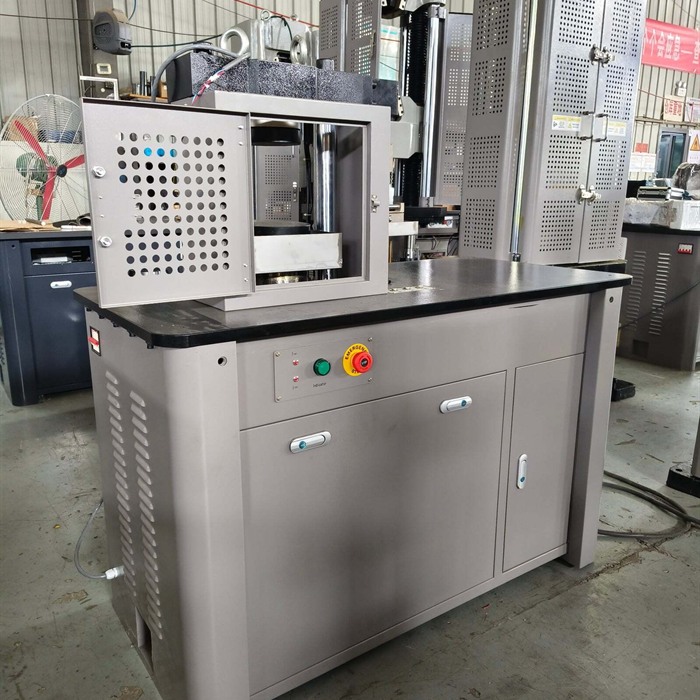
KASON CTM305DW is a dual-purpose compression and flexural Testing Machine for cement, mortar, brick, dimension stone and concrete. It pairs a 300 kN compression frame with a 10 kN flexural station, so one bench serves programmes written to ASTM C170, ASTM C880, DIN 1164, ISO 679, ASTM C109/C109M, ASTM C348, ASTM C349 and BS EN 196-1. Servo motor acceleration and deceleration control drive the loading cycle, while the load value, loading speed and loading curve are displayed and stored in real time.
Key Takeaways
- One frame, two Test modes: 300 kN compression and 10 kN flexural capacity cover mortar prisms, dimension stone and concrete specimens without a second press.
- The closed-loop control system constantly monitors the test in progress and regulates the Testing rate, so the loading condition stays where the method prescribes it.
- Class 1 accuracy across 2%-100% of full scale, with 0.01 mm displacement resolution and a 0.01-40 mm/min displacement speed range.
- The oil-free drive keeps the laboratory clean and quiet, while overload and over-travel protection guard both operator and machine.
What the CTM305DW Is Designed For
The machine tests the mechanical properties of cement, mortar, brick, concrete and other building materials. Pre-built test methods ship for cement mortar, concrete prism and dimension stone, and user-configurable methods are available when a laboratory runs its own procedure. Test data is processed, stored and printed automatically, and report templates can be customised to match house documentation formats.
Why Loading-Rate Control Decides Whether a Result Is Valid
Compressive and flexural strength values are only comparable when the specimen is loaded at the rate the method requires. The CTM305DW uses a closed-loop control system that constantly monitors the test in progress and regulates the testing rate to maintain the prescribed conditions. Stress rate is controllable from 0.05 to 10 kN/s, so a cement mortar prism and a dimension stone specimen can each be run inside its own envelope on the same machine. Real-time software tracks the test and logs the load value, loading speed and loading curve.
Built for the Laboratory Bench
The compact design requires less room in the laboratory, and the oil-free drive system removes hydraulic oil handling, filtration and disposal from the maintenance schedule while lowering noise. A stable, high-intensity load frame with an extended tabletop provides extra area for additional jigs, so the platform can be extended later with hardware and software options rather than replaced.
Standards and Materials Covered
The datasheet lists the following method coverage. Match it against the specimen geometry and expected failure load of your own programme before ordering:
- Cement and mortar strength: ISO 679, DIN 1164, BS EN 196-1
- Flexural strength of hydraulic cement mortar: ASTM C348
- Compressive strength of hydraulic cement mortar: ASTM C109/C109M, ASTM C349
- Dimension stone: ASTM C880/C880M (flexural strength), ASTM C170/C170M (compressive strength)
- Hardened concrete flexural strength: EN 12390-5, BS 1881:118, ASTM C78, ASTM C293, AASHTO T97
Maximum flexural force is 10 kN. That is comfortable for 40 × 40 × 160 mm mortar prisms and for stone prisms, but a standard 150 × 150 mm concrete beam normally fails well above 10 kN. Confirm specimen dimensions against the applicable method, or review the higher-capacity concrete compression platforms.
Frequently Asked Questions
1. Which materials can the CTM305DW test?
Cement, mortar, brick, concrete and other building materials. Typical specimens are 40 × 40 × 160 mm mortar prisms for flexural and compression testing, dimension stone prisms, and concrete prisms. The built-in methods cover the cement mortar, concrete prism and dimension stone categories, and custom methods can be configured.
2. How does the machine keep results comparable between operators?
The closed-loop control system monitors the test in progress and regulates the testing rate to maintain the prescribed conditions instead of relying on pump behaviour. Together with Class 1 accuracy across 2%-100% of full scale and 0.01 mm displacement resolution, the loading path is repeatable between runs and between operators.
3. Is a separate flexural machine still required?
Not for mortar and dimension stone programmes that sit inside the 10 kN flexural envelope. For hardened concrete beam methods such as ASTM C78, ASTM C293 or EN 12390-5, check the specimen dimensions and expected failure load first, because a standard 150 × 150 mm beam usually fails above 10 kN.
4. What maintenance does the oil-free drive need?
There is no hydraulic oil to change, filter or dispose of. Routine care is limited to keeping the platens and specimen contact faces clean and verifying load indication with a load cell calibration tool at the interval your quality system requires.
5. Can the platform be expanded later?
Yes. Optional hardware and software modules can be added afterwards, so the test solution grows with the laboratory instead of being replaced.
Contact me if you are interested!
Email: admin@jnkason.com
Whatsapp: +86 15910081986